


LittleMum Spring-Assisted Seated Lumbar Traction System
LittleMum Spring-Assisted Seated Lumbar Traction System
Body-weight stretcher, Designed by LittleMum
Couldn't load pickup availability
A ceiling-mounted lumbar traction system designed to provide progressive spinal unloading as the user moves gradually from standing to a seated position.
Two matched banks of extension springs connect to a supportive thoracic harness. As the user sits down, the springs extend and provide an upward supporting force through the upper body while the pelvis settles onto the chair.
Each spring has been formally measured at different extension lengths. The supplied force guide allows the approximate combined spring-system lift to be selected using both the number of springs and the measured extension distance.
The harness combines a padded thoracic vest, steel-reinforced moulded PU support blocks and forearm loops to distribute the supporting load across several contact areas rather than relying entirely on arm strength.
Designed for adults who have been assessed as suitable for lumbar traction—particularly those who have previously experienced relief from professionally supervised traction or spinal unloading.
Key benefits
- Measured spring-system lift rather than vague low, medium or high settings.
- Progressive loading as the user moves gradually from standing to sitting.
- Balanced bilateral support through two matched spring assemblies.
- Seated upright use without inversion or a large floor-based traction table.
- Steel-reinforced moulded PU supports designed to spread contact beneath the arms.
- Padded thoracic harness and forearm loops provide additional load distribution.
- Reproducible setup using spring number, extension distance, strap height and chair position.
- Non-electric design with no pump, water bag, battery or motor.


Prefer to buy on Amazon?

Designed Around the Problem
Generating an upward pull is only one part of seated lumbar traction. The greater challenge is supporting the upper body while allowing the pelvis to lower in a controlled way.
- LittleMum was developed to combine progressive spring assistance with an upright seated setup.
- Two balanced spring assemblies support a purpose-designed thoracic harness. As the user moves gradually towards the chair, spring extension—and therefore the upward supporting force—increases progressively.
- The harness uses a padded vest, steel-reinforced moulded PU support blocks and forearm loops to distribute the load across the upper torso and arms.
- The result is a home system designed to make seated lumbar unloading more measurable, repeatable and controllable.
How the Design Works
-
Measured Bilateral Spring Support
Two matching banks of extension springs support the harness from the left and right sides.
Each spring has been formally measured at different extension lengths. Using the same number of springs on both sides helps maintain a balanced upward response.
The approximate combined system lift can therefore be selected from recorded force data rather than sensation alone.
-
Progressive Standing-to-Seated Loading
The springs begin to extend as the user gradually lowers towards the chair.
This means the supporting force develops progressively rather than being applied all at once. The user remains able to reduce the load by standing back up.
Chair height, strap length and the difference between standing and seated height all influence the spring extension.
-
Distributed Upper-Body Support
Seated lumbar traction requires the upper body to be supported while the pelvis settles onto the chair.
LittleMum combines a padded thoracic vest, steel-reinforced moulded PU support blocks and forearm loops to distribute the load across several contact areas.
The support blocks provide a stable, shaped surface, while the forearm loops allow part of the load to be shared through the arms when preferred.
How to Use

Measured Spring Support—not Guesswork
LittleMum has formally measured the springs across a range of extension distances. The supplied chart records the approximate combined lift produced by the two matched spring assemblies at each listed configuration. The guide helps users:
- select the recommended introductory configuration;
- understand how extension distance changes the supporting force;
- keep the left and right spring settings balanced;
- reproduce a previous setup;
- progress gradually rather than making an unmeasured increase.
The chart describes the combined spring-system lift. It should not be interpreted as the exact force transmitted to an individual lumbar segment, because harness fit, contact pressure, posture, forearm support and chair position can affect how the load is transferred through the body.

How to Use
- Do not begin by trying to create the strongest possible pull or by treating the highest value in the force chart as a target.
- Start with the lowest balanced configuration recommended in the supplied guide. Check both the spring response and the pressure created by the harness before increasing either the extension distance or the number of springs.
- Support pressure beneath the arms and around the upper rib cage should feel broad, stable and tolerable. It should not feel sharp, highly localised or progressively more painful.
- The moulded PU support blocks should rest against the upper side-rib area immediately below the underarm fold. They should not be driven deeply into the centre of the armpit.
- The forearm loops may be used to share part of the load and reduce reliance on one contact area.
Is This Product Right for You?
-
This may suit you if
- You have been assessed as suitable for lumbar traction.
- You have previously experienced relief from professionally supervised traction or spinal unloading.
- You want a measurable and progressively adjustable home system.
- You prefer seated upright unloading rather than inversion.
- You want to avoid relying entirely on hand grip or arm strength.
- You are able to follow a spring-force and setup guide carefully.
- You have a suitable ceiling structure and can arrange safe installation.
- You can independently enter, control and exit the seated position.
- You can tolerate broad support pressure around the upper side-rib and underarm region.
-
Consider another option if
- You have ordinary occasional back tension and have not been advised to use lumbar traction.
- You have never established whether spinal unloading improves or aggravates your symptoms.
- You require a portable product with no ceiling installation.
- You cannot tolerate pressure beneath the arms or around the upper rib cage.
- You have significant shoulder, arm or chest-wall problems that make the harness unsuitable.
- You cannot independently stand up to unload the springs.
- You are pregnant or have spinal instability, severe osteoporosis, a spinal infection, metastatic bone disease, an aortic aneurysm, high-grade spondylolisthesis or a recent spinal injury.
- You have undergone lumbar surgery and have not received specific clearance from your treating clinician.
What It Does Well — and What to Consider
-
What to consider
- Secure ceiling installation is required.
- The ceiling structure and fixing method must be suitable for the applied load.
- Correct setup requires an initial learning process.
- Both sides must use matching spring numbers and similar extension.
- Some pressure beneath the arms or around the upper rib cage is unavoidable in seated upright traction.
- Harness comfort varies with chest shape, shoulder width and body size.
- The force chart measures spring-system lift—not the exact force applied to the lumbar spine.
- The product is less portable than a belt, foam stretcher or inflatable device.
- Greater spring force is not necessarily more effective.
-
What it does well
- Provides measured spring-system lift guidance.
- Allows progression through both spring number and extension distance.
- Uses balanced left and right spring assemblies.
- Develops the supporting force progressively as the user sits down.
- Allows seated upright use without inversion.
- Makes a previous setup easier to record and reproduce.
- Reduces reliance on continuous hand grip or arm strength.
- Uses steel-reinforced moulded PU support blocks rather than narrow fabric straps alone.
- Combines thoracic support, underarm support and optional forearm load sharing.
- Uses no pump, water bag, motor, battery or electricity.

Built as a Complete Traction System
Every major component has a role in generating, transferring or distributing the supporting load.
- The two extension-spring assemblies create the adjustable upward response. Stainless steel frameworks, connectors, chains and ceiling attachments transfer that load through the suspension system.
- The harness then distributes the supporting force through several contact areas:
- the padded thoracic vest stabilises the upper torso;
- the steel-reinforced moulded PU blocks provide shaped support beneath the arms;
- adjustable straps help align the left and right sides;
- forearm loops allow part of the load to be shared through the arms.
What to Expect
A Gradual Stretch—not an Instant Correction
The system is designed to temporarily reduce the amount of upper-body load carried through the lumbar region while the user remains in a controlled seated position. For an appropriately selected user, a session may produce:
- a temporary feeling of reduced compression or heaviness in the lower back;
- reduced intensity of some radiating leg symptoms;
- improved tolerance to an upright seated position;
- easier movement immediately after unloading;
- a period of symptom relief that makes prescribed mobility or strengthening work more comfortable.
- Progress may appear as the same measured configuration becoming easier to tolerate or the benefit lasting longer between sessions.
- Individual responses vary. Some users may experience temporary relief, while others may obtain little or no benefit.
Product Details
Can I use it without professional advice?
The product is most appropriate for people who have already been assessed as suitable for lumbar traction or who have previously experienced a clear positive response during supervised treatment.
Seek professional advice before use if you are uncertain about your diagnosis, suitability or starting configuration.
How long should a session last?
Follow the introductory duration and progression schedule in the updated User Guide or the instructions provided by your treating healthcare professional.
Do not continue solely to reach a time target. End the session if harness pressure or neurological symptoms increase.
Is more spring force better?
No.
The goal is to find the lowest controlled configuration that is both tolerable and appropriate for your symptoms.
More force may increase harness pressure without producing greater benefit.
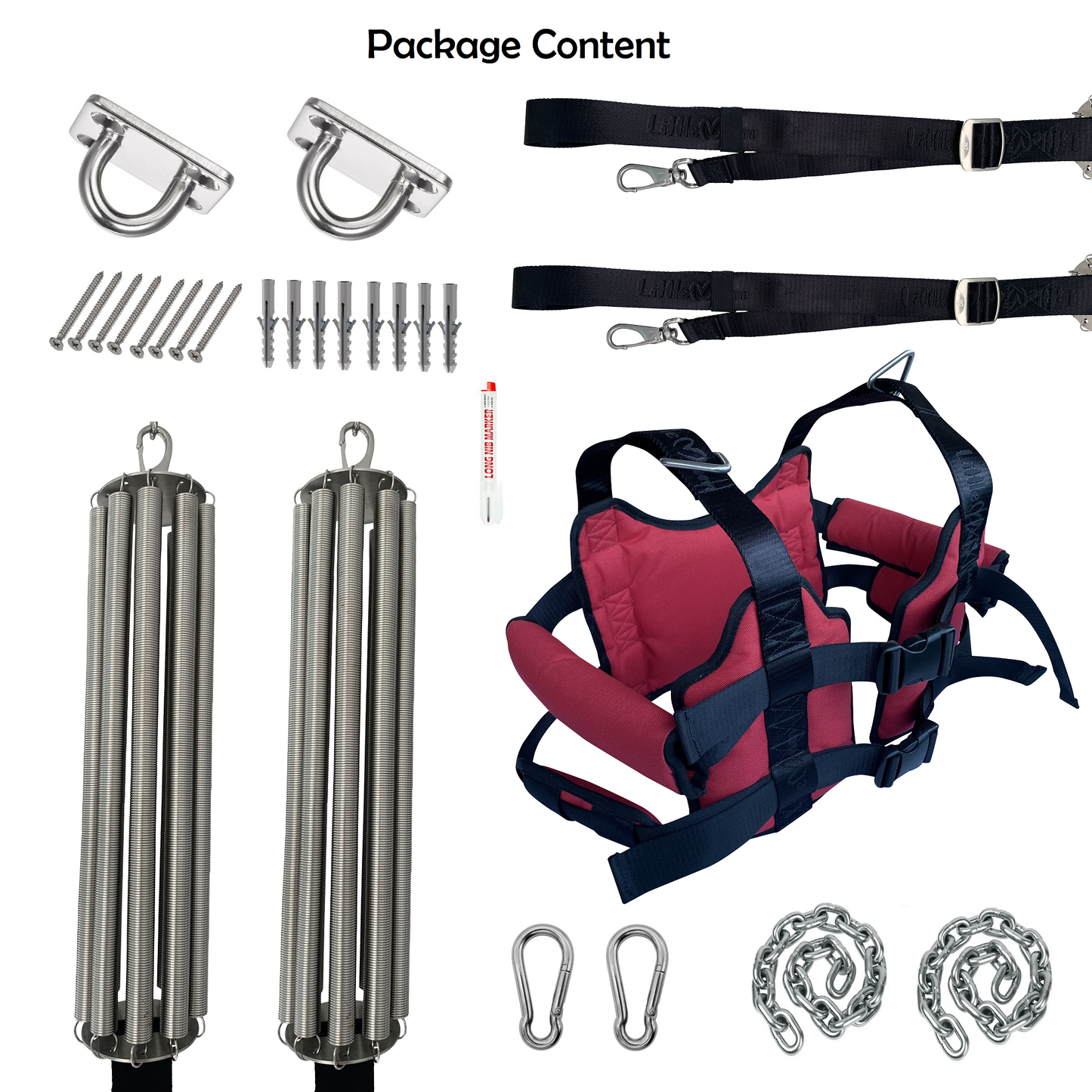
What’s Included
- 2 × spring cylinder assemblies
- Up to 10 extension springs within each assembly.
- 2 × ceiling suspension hooks
- 2 × carabiners
- 2 × chain links
- 1 × adjustable thoracic harness
- 2 × steel-reinforced moulded PU support blocks
- Installation anchors and screws
- Installation marker
- User Guide with measured spring-force charts
Materials
- 304 stainless steel spring frameworks and extension springs
- Stainless steel connectors, chains and ceiling hardware
- Steel-reinforced moulded PU support blocks
- Padded thoracic vest with nylon outer fabric
- Adjustable nylon webbing straps
- Quick-release buckles
- Forearm support loops
Intended Use
Designed for controlled home cervical traction in adults who have been assessed as suitable for this treatment method.
The system applies an upward traction response through a suspended head halter and multiple parallel extension springs.
Use only in accordance with the supplied installation, measured-force and progression guide.
How the System Creates Lift
Two matched banks of parallel extension springs connect to the left and right sides of the thoracic harness.
As the user lowers towards the chair, the springs extend and produce an upward supporting force through the harness.
The pelvis and lower body settle onto the chair while the upper body remains partially supported, creating the seated unloading effect.
Measured Spring-Force Guide
The supplied chart records the approximate combined lift produced by the two spring assemblies at different extension distances and matched spring configurations.
The table covers spring deflection distances from 35 cm / 13.77 in to 69 cm / 27.16 in.
“4 × 2” means four springs on each side. Both sides must use the same number of springs, arranged symmetrically.
The chart represents combined spring-system lift and not the exact traction force reaching an individual lumbar segment.
Maximum Spring Extension
The springs have a stated maximum working deflection of 69 cm / 27.16 in.
Do not extend the complete spring length beyond 104 cm / 40.9 in.
Excessive extension may permanently deform the springs or damage the system.
Harness and Support Blocks
The harness includes a padded thoracic vest, adjustable straps, two steel-reinforced moulded PU support blocks and forearm support loops.
Position the PU blocks against the upper side-rib area immediately below the underarm fold. Do not force them deeply into the armpit.
The vest should be secure without restricting normal breathing.
Fit Range
The adjustable harness is designed to accommodate body circumferences up to approximately 60 in / 152 cm.
Suitability also depends on chest shape, shoulder width, underarm position and the user’s ability to tolerate the support interface.
Circumference alone does not guarantee a comfortable fit.
Chair Requirements
Use a stable chair without wheels.
Both feet should rest flat on the floor, with the knees approximately level with the hips.
Avoid chairs that are excessively padded or unstable.
Position the centre of the chair beneath the midpoint between the two ceiling suspension points.
Installation Requirements
Install the two ceiling suspension points into an appropriate structural support.
The recommended distance between the two suspension points is approximately 10 in / 26 cm, aligned with the shoulder attachment points of the harness.
Professional installation is recommended if there is any uncertainty about the ceiling structure, fixing method or load capacity.
Do not rely on plasterboard or a decorative ceiling surface to support the system.
When to Stop
Stand up and unload the springs immediately if you experience:
- symptoms travelling further down the leg;
- new or increasing weakness or numbness;
- sharp or increasing back pain;
- numbness, tingling or weakness in either arm;
- sharp or highly localised underarm pressure;
- difficulty breathing;
- dizziness or faintness;
- colour or temperature changes in the hands; or
- difficulty standing up or exiting the system.
Seek urgent medical assessment for new bladder or bowel problems, saddle-area numbness or rapidly worsening weakness in both legs.
说明书中的安装尺寸、弹簧配置、最大伸长、材料和现有配件均来自原User Manual。
12. Frequently Asked Questions
Who is this product designed for?
It is designed for adults who have been assessed as suitable for lumbar traction, particularly people who have already experienced relief from professionally supervised traction or spinal unloading.
It is not designed as a first-line product for every person with ordinary lower-back pain.
How does seated lumbar unloading work?
The pelvis settles onto a stable chair while the spring-supported harness provides an upward supporting force through the upper body.
This temporarily reduces part of the upper-body load carried through the lumbar region.
How is the system different from an inversion table?
An inversion table uses gravity while the body is tilted or inverted.
LittleMum keeps the user upright and creates the supporting force through two measured spring assemblies as the user moves from standing to sitting.
Neither method is suitable for every person.
How is it different from a simple hanging decompression strap?
Simple straps may rely heavily on the arms, a door frame or an unmeasured sitting depth.
LittleMum combines matched spring assemblies, measured extension data, a structured thoracic harness, steel-reinforced moulded PU supports and forearm load-sharing loops.
Will I feel pressure beneath my arms?
Some support pressure beneath the arms and around the upper side-rib area is expected because the upper body must be supported during seated unloading.
The moulded PU blocks, thoracic vest and forearm loops are designed to distribute this pressure, but they cannot eliminate it completely.
The pressure should feel broad and tolerable—not sharp, highly localised or progressively stronger.
Stand up and unload the system if you develop pain, tingling, numbness, arm weakness or changes in hand colour or temperature.
Where should the support blocks sit?
Position them against the upper side-rib area immediately below the underarm fold.
Do not push the blocks deeply into the centre of the armpit.
Small changes in strap height can significantly affect comfort, so adjust both sides evenly before sitting down.
What are the forearm loops for?
The loops allow the forearms to share part of the supporting load.
They may reduce reliance on one contact area, but using them should not require forceful gripping or sustained shoulder effort.
How is the spring-system lift selected?
Measure the difference between the standing and seated setup positions and refer to the supplied force chart.
Use the same number of springs on both sides and arrange them symmetrically.
Begin with the introductory configuration stated in the guide rather than attempting to maximise the lift.
Is the chart the exact force applied to my lumbar spine?
No.
The chart records the approximate combined lift generated by the spring system. Harness fit, posture, chair height, underarm contact and forearm support affect how much of that force is transferred through the body.
It should be used as a setup and progression guide—not as a direct measurement of force at a particular spinal segment.
Is more spring force better?
No.
The goal is to find the lowest controlled configuration that is both tolerable and appropriate for your symptoms.
More force may increase harness pressure without producing greater benefit.
Can it be used for sciatica or a herniated disc?
A diagnosis alone does not determine whether traction is appropriate.
Some selected users with radiating leg symptoms may experience temporary relief from unloading, while others may not benefit or may feel worse.
Use the product only after confirming that lumbar traction is suitable for your individual condition.
Can it realign my spine or repair a disc?
The system provides temporary seated unloading during use.
It cannot guarantee permanent spinal realignment, repair a damaged disc, reverse degeneration or prevent surgery.
How long should a session last?
Follow the introductory duration and progression schedule in the updated User Guide or the instructions provided by your treating healthcare professional.
Do not continue solely to reach a time target. End the session if harness pressure or neurological symptoms increase.
这里暂时不复制旧说明书的“总计30–60分钟”。这个时长在新版安全说明完成前不适合作为普通客户的默认目标。
Can I use it without professional advice?
The product is most appropriate for people who have already been assessed as suitable for lumbar traction or who have previously experienced a clear positive response during supervised treatment.
Seek professional advice before use if you are uncertain about your diagnosis, suitability or starting configuration.
13. Customer Reviews
Heading
Real Experiences from LittleMum Customers
Intro text
Responses to lumbar traction vary. Reviews are published to help customers understand the setup process, harness contact, learning curve and type of relief they may reasonably expect.
Featured reviews应优先选择包含以下内容的:
原来的症状;
以前是否做过牵引;
弹簧和距离配置;
腋下或胸廓舒适度;
怎样调整support blocks;
是否使用前臂环带;
使用多久后出现什么变化;
哪些地方没有改善。
不要只突出:
Five stars — cured my disc.
14. Related Products
Heading
Choose the Right LittleMum Back-Care Tool
LittleMum Back Trigger Point Massager
Broad body-weight pressure for muscular tightness across the back and gluteal region.
LittleMum Back Deep Tissue Massager
More concentrated pressure for selected muscular areas around the lower back, hips and glutes.
LittleMum Thoracic Flex Stretcher
Supported thoracic extension for upper- and mid-back mobility.
Selection note
Choose the Seated Lumbar Traction System only when lumbar traction or unloading is the intended method.
Choose a Trigger Point or Deep Tissue Massager when the primary concern is muscular tightness rather than spinal traction.
Choose the Thoracic Flex Stretcher when the goal is upper- or mid-back extension rather than lumbar unloading.
SEO
Page title
Seated Lumbar Traction System | LittleMum Care
Meta description
A spring-assisted seated lumbar traction system with measured bilateral lift, progressive standing-to-seated control and a structured load-distributing harness.
URL handle
建议:
spring-assisted-seated-lumbar-traction-system
原来的:
littlemum-back-traction-apparatus
改动时建立301 redirect,不要直接删除旧URL。
页面中应当删除的旧内容
当前产品页或说明书中的以下表达不要继续放进新版:
Improves spinal alignment
Facilitates disc rehydration
Realigns herniated-disc material
Prevents progression of disc herniation
Obviates the necessity for surgery
Temporary pain is normal
Most people improve within 2–4 weeks
这些说法超过现有证据,而且会把产品错误地推向所有腰痛患者。现有权威指南不支持将牵引作为一般腰痛或坐骨神经痛的常规治疗。
这款产品的新核心表达应该是:
Measured spring-assisted seated unloading for people who already know that lumbar traction may be appropriate for them.
Inspection and Care
Inspect the ceiling attachments, springs, frameworks, chains, carabiners, straps, buckles, PU support blocks and harness before every session.
Do not use the system if any load-bearing part is bent, cracked, permanently stretched, corroded, loose or difficult to secure.
Wipe metal components with a soft damp cloth and dry them fully.
Spot-clean the harness and straps using mild soap and water. Do not machine wash, soak, tumble dry or expose them to direct heat.
Allow every fabric component to dry completely before storage.
FAQ
Is the chart the exact force applied to my lumbar spine?
No.
The chart records the approximate combined lift generated by the spring system. Harness fit, posture, chair height, underarm contact and forearm support affect how much of that force is transferred through the body.
It should be used as a setup and progression guide—not as a direct measurement of force at a particular spinal segment.
How is the spring-system lift selected?
Measure the difference between the standing and seated setup positions and refer to the supplied force chart.
Use the same number of springs on both sides and arrange them symmetrically.
Begin with the introductory configuration stated in the guide rather than attempting to maximise the lift.
Who is this product designed for?
It is designed for adults who have been assessed as suitable for lumbar traction, particularly people who have already experienced relief from professionally supervised traction or spinal unloading.
It is not designed as a first-line product for every person with ordinary lower-back pain.
How does seated lumbar unloading work?
The pelvis settles onto a stable chair while the spring-supported harness provides an upward supporting force through the upper body.
This temporarily reduces part of the upper-body load carried through the lumbar region.
How is the system different from an inversion table?
An inversion table uses gravity while the body is tilted or inverted.
LittleMum keeps the user upright and creates the supporting force through two measured spring assemblies as the user moves from standing to sitting.
Neither method is suitable for every person.
How is it different from a simple hanging decompression strap?
Simple straps may rely heavily on the arms, a door frame or an unmeasured sitting depth.
LittleMum combines matched spring assemblies, measured extension data, a structured thoracic harness, steel-reinforced moulded PU supports and forearm load-sharing loops.
Will I feel pressure beneath my arms?
Some support pressure beneath the arms and around the upper side-rib area is expected because the upper body must be supported during seated unloading.
The moulded PU blocks, thoracic vest and forearm loops are designed to distribute this pressure, but they cannot eliminate it completely.
The pressure should feel broad and tolerable—not sharp, highly localised or progressively stronger.
Stand up and unload the system if you develop pain, tingling, numbness, arm weakness or changes in hand colour or temperature.
Where should the support blocks sit?
Position them against the upper side-rib area immediately below the underarm fold.
Do not push the blocks deeply into the centre of the armpit.
Small changes in strap height can significantly affect comfort, so adjust both sides evenly before sitting down.
What are the forearm loops for?
The loops allow the forearms to share part of the supporting load.
They may reduce reliance on one contact area, but using them should not require forceful gripping or sustained shoulder effort.