


LittleMum Spring-Controlled Cervical Traction System
LittleMum Spring-Controlled Cervical Traction System
Body-weight stretcher, Designed by LittleMum
Couldn't load pickup availability
A ceiling-mounted cervical traction system designed for adults who have been advised that home cervical traction is appropriate.
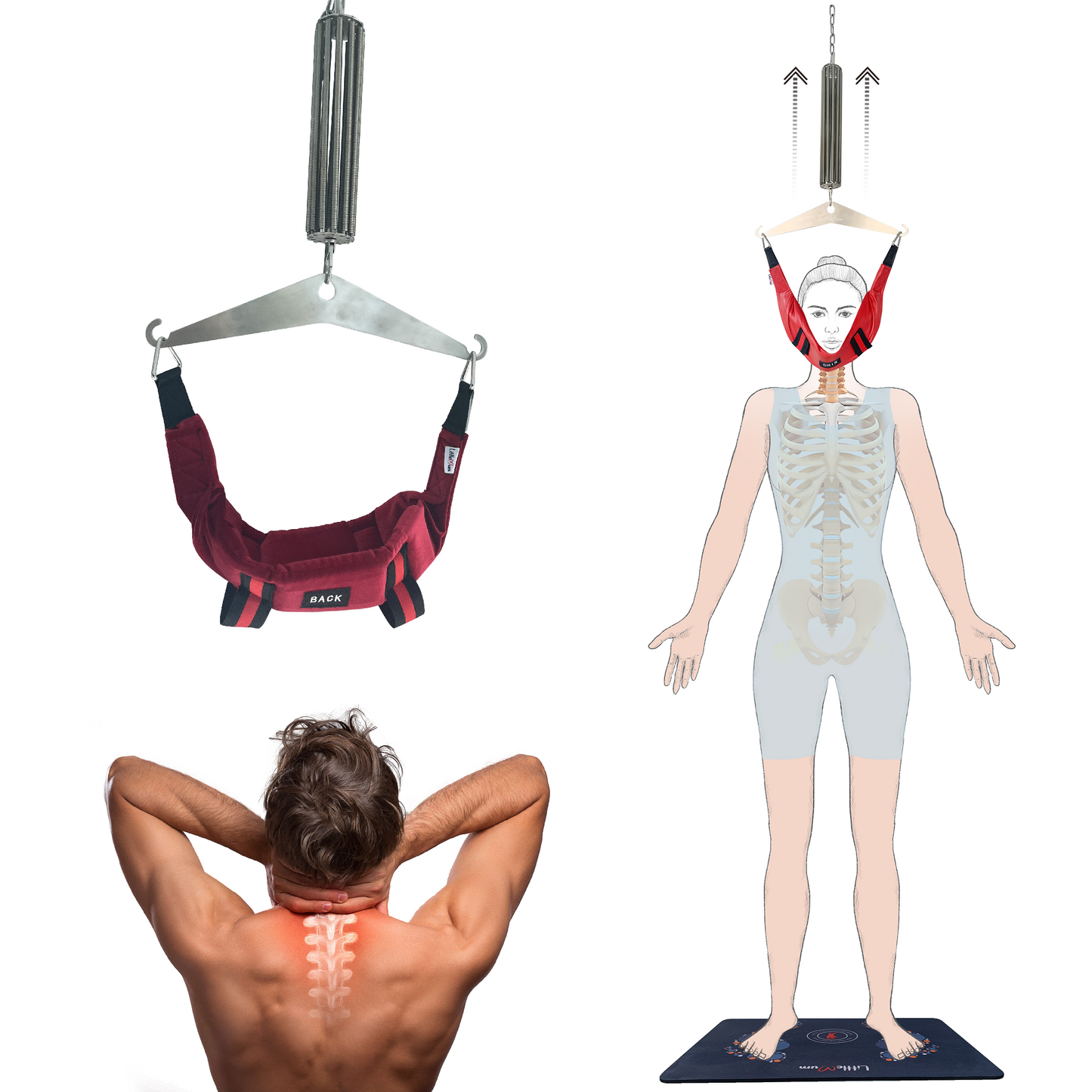
LittleMum uses multiple parallel extension springs rather than a fixed hanging weight or inflatable collar. Each spring has been formally measured at different extension lengths, allowing the approximate traction load to be understood through both spring number and spring extension.
The system can be configured for standing or seated use and allows the traction response to be introduced progressively rather than applied as one fixed setting.
Key benefits
- Measured traction-force guidance based on spring extension and spring number.
- Progressive adjustment without pumps, water bags or powered motors.
- Responsive spring suspension that extends and recovers as the body settles.
- Standing or seated use beneath a securely installed ceiling anchor.
- Complete traction system with load-bearing stainless steel components, padded head halter and positioning mat.
Designed for: Adults who have been assessed as suitable for cervical traction, particularly those managing cervical radiculopathy or neck symptoms that radiate into the shoulder or arm.
Not designed for: Occasional muscular neck tension, recent neck injury, self-diagnosis or conditions for which cervical traction has not been confirmed as appropriate.


Prefer to buy on Amazon?

Designed Around the Problem
Cervical traction is not simply a matter of pulling harder. Too little traction may produce no meaningful response. Too much, too quickly, may feel uncomfortable or aggravate symptoms. Yet many home devices provide only a fixed hanging weight, inflatable pressure or vague settings described as low, medium and high. LittleMum was developed around a different question:
Could home cervical traction be measurable, progressive and responsive? The result is a parallel spring system. The user selects the spring configuration, observes the spring extension and refers to measured force data to understand the approximate traction load. Instead of relying on one fixed pulling method, the system allows traction to be introduced and reproduced in controlled stages.
How the Design Works
-
Measured Force at Different Extensions
The pulling force of an extension spring changes as the spring length changes. Each LittleMum spring has therefore been formally measured at multiple extension lengths. The supplied force chart shows the approximate force produced by one spring at each measured point. This allows the user to work from recorded data rather than relying only on sensation.
-
Progressive Parallel-Spring Adjustment
Multiple identical springs work together in parallel. The approximate combined traction load is determined by both the measured force of each spring at the observed extension and the number of springs carrying the load. This allows the system to begin at a lower configuration and progress through controlled, reproducible stages.
-
Responsive Upright Suspension
The springs extend as the user gradually enters the traction position and recover as the load changes. This creates a responsive suspension rather than a completely static hanging weight. The ceiling-mounted design allows the user to remain standing or seated beneath the anchor point while maintaining an upright body position.
How to Use

How to Use
Cervical traction should begin with the correct screening, installation and starting load—not with the strongest configuration.
Use the measured force chart and the progression schedule in the supplied guide to select the recommended introductory setting. Confirm both the number of springs and their approximate extension before increasing the load.
Enter the traction position slowly. The sensation should feel controlled and tolerable rather than sharp, forceful or unstable.
Stop and unload the system if symptoms become stronger, travel further into the arm or hand, or are accompanied by new weakness, numbness, dizziness, visual disturbance, severe headache or loss of balance.
Is This Product Right for You?
-
This may suit you if
- You have been assessed as suitable for cervical traction.
- You experience neck symptoms that radiate into the shoulder or arm.
- Cervical traction used during physiotherapy has previously reduced your symptoms.
- You want measurable, progressively adjustable home traction.
- You prefer an upright standing or seated system rather than a floor-based device.
- You are willing to follow a measured force and progression guide.
- You have a suitable ceiling structure and can arrange safe installation.
-
Consider another option if
- Your symptoms are limited to occasional muscular tightness and do not require cervical traction.
- You have not been assessed to determine whether traction is appropriate.
- You need a portable device that requires no permanent installation.
- You cannot tolerate pressure from a head halter around the jaw, chin or back of the head.
- You require clinician-controlled or mechanically programmed traction.
- You cannot safely monitor the setup, spring extension or your symptom response.
- You have a recent injury, suspected cervical instability or progressive neurological symptoms.
- You have been advised not to use cervical traction.
What It Does Well — and What to Consider
-
What to consider
- The stretch can feel strong if you begin without enough head and shoulder support.
- The height is fixed; intensity is adjusted through pillows, surface and body position.
- It is designed for gradual mobility work—not aggressive back cracking.
- A fixed shape will feel different depending on body size, spinal curvature and current mobility.
- It does not replace strengthening, posture work or a complete rehabilitation programme.
- TOS is not a single condition, and not every type is appropriate for independent stretching.
-
What it does well
- Provides measured traction-force guidance rather than vague intensity labels.
- Allows progression through both spring number and spring extension.
- Makes a previous configuration easier to reproduce.
- Responds elastically as the user enters and settles into the traction position.
- Allows standing or seated upright use.
- Avoids pumps, inflatable chambers, water bags, batteries and motors.
- Uses a spreader bar and padded head halter to transfer the traction load.
- Includes the suspension, positioning and connection components as one complete system.
- Uses durable materials in the load-bearing structure.

Built as a Complete Traction System
Every component has a specific role in carrying, transferring or controlling the traction load.
- The extension springs generate the adjustable traction response. The stainless steel structure, chain, connectors and ceiling suspension components transfer the load through the system.
- The spreader bar helps maintain the position and width of the head halter. Customers can choose between a smooth velvet or genuine sheepskin contact surface.
- The natural-rubber positioning mat helps the user return to a consistent standing location beneath the suspension point.
- These materials were chosen for structural performance, contact comfort and durability—not simply for appearance.
What to Expect
A Gradual Stretch—not an Instant Correction
Cervical traction applies a longitudinal pulling force through the neck. Its intended effect is to temporarily reduce compression and tension around cervical joints, muscles and irritated nerve roots. For appropriately selected users, consistent use may help:
- reduce neck pain that travels into the shoulder or arm;
- reduce the intensity or frequency of some nerve-related symptoms;
- decrease the feeling of compression, stiffness or muscular guarding;
- improve tolerance to upright head and neck positioning;
- make prescribed mobility or strengthening exercises more comfortable;
- provide periods of symptom relief that support normal daily activity.
Early improvement may be noticed as arm symptoms become less intense, travel less far from the neck, or settle more quickly after a session. Some users may first notice that the same measured load becomes easier to tolerate. Progress is not always linear. A stronger configuration is not necessarily a sign of better recovery, and the goal is not to use the maximum possible force.
Longer-term improvement depends on the underlying cause of the symptoms and is more likely when traction is combined with appropriate exercise, mobility work, postural changes and professional treatment where needed.
Product Details
Intended Use
Designed for controlled home cervical traction in adults who have been assessed as suitable for this treatment method.
The system applies an upward traction response through a suspended head halter and multiple parallel extension springs.
Use only in accordance with the supplied installation, measured-force and progression guide.
Measured Spring Force
Each spring has been formally measured at multiple extension lengths.
Refer to the supplied force chart to identify the measured force produced by one spring at the observed extension. When identical springs work in parallel at the same extension, their forces combine to produce the approximate total traction load.
Confirm both spring number and extension length before progressing.
Add or remove springs only when the system is completely unloaded.
Installation Requirements
The system must be attached to a suitable ceiling structure using correctly selected and installed load-bearing hardware.
The suspended apparatus measures approximately 80 cm / 31.5 in, excluding the adjustable chain.
As a general space guide, the ceiling height should be approximately the standing user’s height plus at least 80 cm / 31.5 in, with additional clearance where required by the installation.
Arrange professional installation if you are uncertain about the ceiling structure, fixing method or safe load capacity.
Materials
304 stainless steel structural and load-bearing components.
Parallel stainless steel extension springs.
Stainless steel chain and connection hardware.
Padded velvet or genuine sheepskin head halter. Natural-rubber positioning mat.
Non-electric construction with no motor, battery, pump or inflatable chamber.
Inspection and Care
Inspect the ceiling connection, springs, chain links, connectors, spreader bar and head halter before every session.
Do not use the system if a load-bearing component is bent, cracked, deformed, loose, corroded or difficult to secure.
Wipe the metal components with a soft damp cloth and dry fully.
Follow the supplied cleaning instructions for the selected velvet or sheepskin head halter.
Do not modify, substitute or combine load-bearing components with unapproved parts.
What’s Included
Spring-controlled cervical traction assembly
Adjustable suspension chain
Spreader bar
Head halter in the selected material
Natural-rubber positioning mat
Ceiling suspension hook
Installation anchors and screws
Installation marker
User Guide with measured spring-force chart and progression instructions
When to Stop
Stop and unload the system immediately if you experience:
- new or increasing pain;
- symptoms travelling further into the shoulder, arm or hand;
- new weakness, numbness or loss of coordination;
- dizziness, visual disturbance, nausea or severe headache;
- difficulty with balance or walking; or
any feeling that you cannot safely control or exit the traction position.
Seek professional assessment if new or worsening symptoms continue.
Shipping & Returns
Free shipping is available within the United States, Australia, and Canada.
Returns are accepted within 30 days. We provide the return label, and a flat $5 return fee is deducted from the refund in USA. Please review our Returns Policy for full eligibility requirements.
FAQ
Who is this product designed for?
It is designed for adults who have been assessed as suitable for cervical traction, particularly people managing cervical radiculopathy or neck symptoms that radiate into the shoulder or arm.
A diagnosis such as disc degeneration or spondylosis alone does not automatically mean that cervical traction is suitable.
How is the traction force determined?
Traction force depends on two variables:
- the measured force of one spring at the observed extension length; and
- the number of springs operating in parallel.
The supplied chart records the force of one spring at different extension lengths and is used to determine the approximate combined load.
Is adding more springs always better?
No.
More springs increase the system’s resistance, but a stronger setting does not automatically produce a better result.
Use the lowest measured configuration that produces a controlled and appropriate traction response, following the supplied progression guide.
How is this different from an over-the-door traction device?
Many over-the-door devices use a hanging weight, pulley or elastic component and restrict the user to a position close to the door.
LittleMum uses multiple measured extension springs suspended from a ceiling anchor. This allows the traction load to be adjusted progressively and used in an upright standing or seated position.
Can it be used standing or seated?
Yes, provided the suspension height, head halter and body position are configured correctly and the user can enter and exit the position safely.
Follow the setup instructions for the chosen position.
Can it permanently correct cervical alignment?
The system applies cervical traction during use. It cannot guarantee permanent correction of cervical curvature, disc height, vertebral position or degenerative changes.
Structural findings should be assessed by a qualified healthcare professional.
When should I stop using it?
Stop immediately if symptoms become stronger, spread further into the arm or hand, or are accompanied by weakness, numbness, dizziness, visual disturbance, severe headache, loss of balance or difficulty controlling the position.
Seek professional advice if new or worsening symptoms continue.